
India's defence exports have surged to a record high of ₹23,622 crore (approximately $2.76 billion) in FY 2024-25, representing a 34-fold increase over the past decade. Successful missile tests, indigenous platforms rolling out of production lines, and growing global partnerships signal our rising capabilities.
In the Prime Minister’s recent address at the World Leaders Forum and earlier, the announcement of developing the Sudershan Chakra by 2035, I reckon the core central message was speed - the idea that for India to lead, it must now evolve at the speed of the developed world(or faster maybe?).India is no longer just imagining deterrence through posture or procurement - but through architecture, through a defence-industrial engine that can move not over decades, but over months and towards missions.
This raises a fascinating question: What is the underlying physics of national speed? What are the core layers of a sovereign defence stack, and how do we generate enduring velocity - the kind that compounds progress and capability over time.
Here’s a lens to view it, a perspective probably not novel but I’m scribbling it out nonetheless.
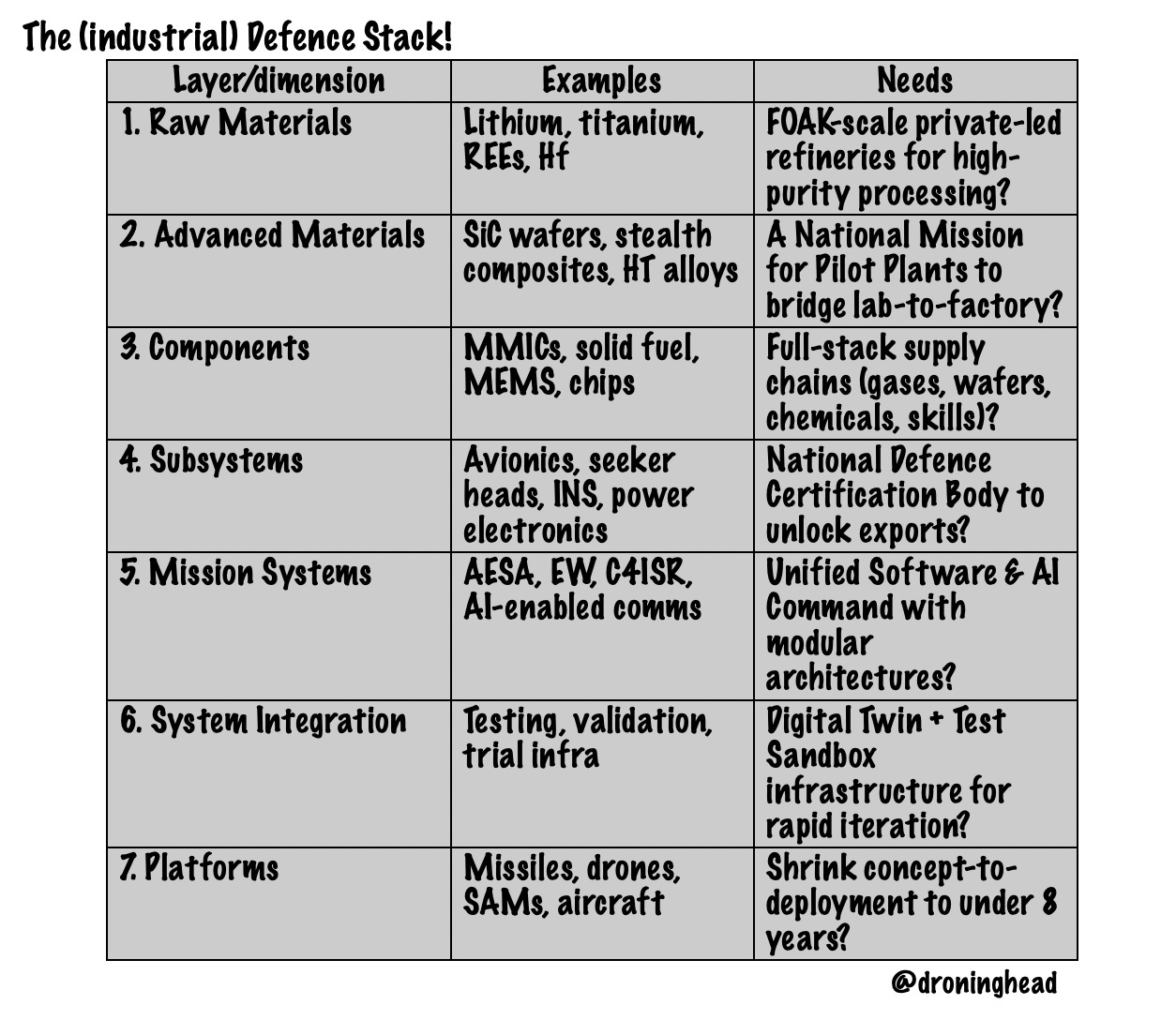
In an ideal scenario, true strategic autonomy would emerge from mastering and/or owning each layer of the industrial stack - from raw materials to finished platforms. Each layer represents both a current capability gap and a future opportunity for exponential growth. Now, we may not be able to achieve 100% sovereign capabilities across all layers for all platform but it’s an audacious goal worth setting eyes on!
Unpacking the layers/dimensions
Each the layer/dimension represents both a current gap and a future opportunity.
Layer 7 - Platforms: The imperative of speed
At the apex sit the final, finished systems visible to the naked eye: Tejas fighters, BrahMos missiles, Arjun tanks, and the likes and owing to recent changes in warfare, joining this elite group would be drones not Kamikaze but MALE. Here, the opportunity is transformational: collapsing traditional 15-year development cycles into agile 5-7 year sprints through iterative development, continuous user feedback, and even the debatable spiral development approach to dance toe-to-toe with faster than ever changes in technology and warfare.Give upstarts a bigger chance here
I’m sure the model exists, I mean as reference points, Israel's defence industry moves from concept to deployment in the blink of an eye and China's military-industrial complex has accelerated innovation cycles in recent times.
Layer 6 - System Integration: The challenge of complexity
India possesses highly capable system integrators - HAL, BEL, DRDO labs and private players like Kalyani Defence, L&T and Tata Advanced Systems. The unlock here is digital: what if we create a National Defence Digital Twin ecosystem that enables virtual prototyping, system-level simulation, and rapid iteration before physical integration and testing begins.
Imagine creating a unified yet distributed digital sandbox where every component, subsystem, and platform can be modeled, tested, and optimized in virtual environments before the first piece of metal is cut.
Layer 5 - Mission Systems: The software-defined future
Modern platforms are increasingly defined by their software architecture. While India has achieved hardware victories, viz., our AESA radars, electronic warfare systems, and missile guidance packages, the next frontier is cognitive - making these systems think-then-act, faster and smarter.
The opportunity lies in establishing an AI supported, software command capability focused on building open, secure, and modular architectures that form the digital nervous system of future platforms.(Don’t think of Terminator and the rise of machines !)
Layer 4 - Subsystems: The trust equation
Companies like Data Patterns, MTAR Technologies, Astra Microwave, and Centum Electronics are building world-class subsystems that compete globally. The mission now is scaling trust - creating a National Defence Certification framework that establishes Indian subsystems as synonymous with quality and reliability.
This isn't merely about compliance, it's about engineering a national brand of precision and dependability that enables upstarts to get in the game and to unlock global supply chains for exports.
Layer 3 - Components: The ecosystem multiplier
India's semiconductor mission is gaining tremendous momentum, with major fabs approved and construction beginning. But for sovereign capability - we need the full ecosystem - specialty gases, ultra-pure chemicals, precision tooling, and most critically, the skilled talent pipeline that transforms fabs from standalone facilities into innovation hubs.
The multiplier effect occurs when these ecosystems achieve critical mass, creating virtuous cycles of innovation, investment, and expertise development - just like the software paradigm did.
Layer 2 - Advanced Materials: The translation challenge
Indian research institutions produce world-class R&D in advanced materials: silicon carbide for power electronics, high-temperature superalloys for jet engines, composite materials for aerospace applications. The grand challenge is industrial translation: moving from laboratory breakthroughs to factory-scale production.
What if we have a National network of pilot plants - specialized facilities that bridge the valley of death between research and manufacturing, de-risking technologies for venture capital investment and scaling?
Layer 1 - Raw Materials: The foundation of power
India possesses critical mineral reserves - lithium deposits in Jammu & Kashmir, rare earth concentrations in Odisha, titanium sands along our coasts. The ultimate strategic opportunity is value addition - transforming raw geological wealth into refined materials that feed our own industrial stack.
This demands private-led, first-of-a-kind refineries and processing facilities that climb the value chain.
The engineering challenge of our time
From a builder’s lens, one pattern becomes clear if I were to hazard an approach that could help accelerate innovation by startups, the 3 key anchors/levers would be :
Pilot infrastructure: The missing middle between brilliant research and dependable, scalable products. India needs a national network of pilot plants, demonstration facilities, and technology transition centres that de-risk innovation and accelerate commercial adoption.
Trusting startups to deliver: The responsibility and allowance for innovation must be spread to young companies and founders and for that the traditional L1/L2 model of picking players on the basis of cost-for-specs has to give way to a new paradigm.Both for Sudershan chakra and MALE drones, the approach is to pick L1 and L2 bidders in the ratio of 64% to 36%. this is an opportunity to change - why not carve out 36% for startups and make it an opportunity for them to prove they can deliver.
Integrated quality: Crafting a national language of trust where Indian certification becomes a global asset, not just a compliance requirement. This means establishing standards that are not just the baseline for startups to strive for but recognized internationally as well.
Software sovereignty: Architecting modular, secure, and upgradeable digital backbone for all future platforms. As warfare becomes increasingly software-defined, this layer becomes the most critical differentiator.
Research for capability: Create a Defence Research Grid - a coordinated, mission-aligned network across all leading academic institutions, DRDO, active-duty personnel from the forces and private firms, with accelerated research tracks designed to ignite/guide young minds - a pathway to translate research into capabilities we need.
Warfare is changing, battlefields are moving.The future will not be defined by what we import but it will depend on how quickly we can build what we need next.
India’s defence ambition needs an engine to get there, fast !