
In FY 2024-25 India shipped US $ 24.1 billion worth of smartphones - up 55 % year-on-year and, for the first time, ahead of oil and diamonds on the export leader-board.(The Economic Times).It’s a staggering milestone.
Even with this triumph, manufacturing’s share of our GDP remains stuck at around the mid-teens, a figure that has barely budged for a decade.
This raises two critical questions. One, in a world of rising conflict, can geopolitics turn "China+1" into "China+2" just as easily? And two, if our next decade looks like our last, will we end up as just a bigger, more efficient workshop? The real prize isn't in assembling the world's existing products; it's in winning the right to build the world's first.
The First-of-a-kind (FOAK) imperative
A First-of-a-Kind (FOAK) factory is where a laboratory proof is forged into large-scale reality. It’s the closest thing modern industry has to alchemy: the brutal, uncertain process of transforming a scientific blueprint into a physical product for the very first time.
India can’t afford to sit on the sidelines; the next wave of industrial value will be captured by whoever builds the first plants, not the cheapest copies. Meanwhile, policy tail-winds are real - a ₹ 1.97 lakh-crore Production-Linked Incentive (PLI) war-chest now spans 14 sectors. (Press Information Bureau)
Geo politics is real - last I checked, the number of active and armed conflicts in the world was greater than 10 and for an over all view of ongoing conflicts across the planet, check this map.
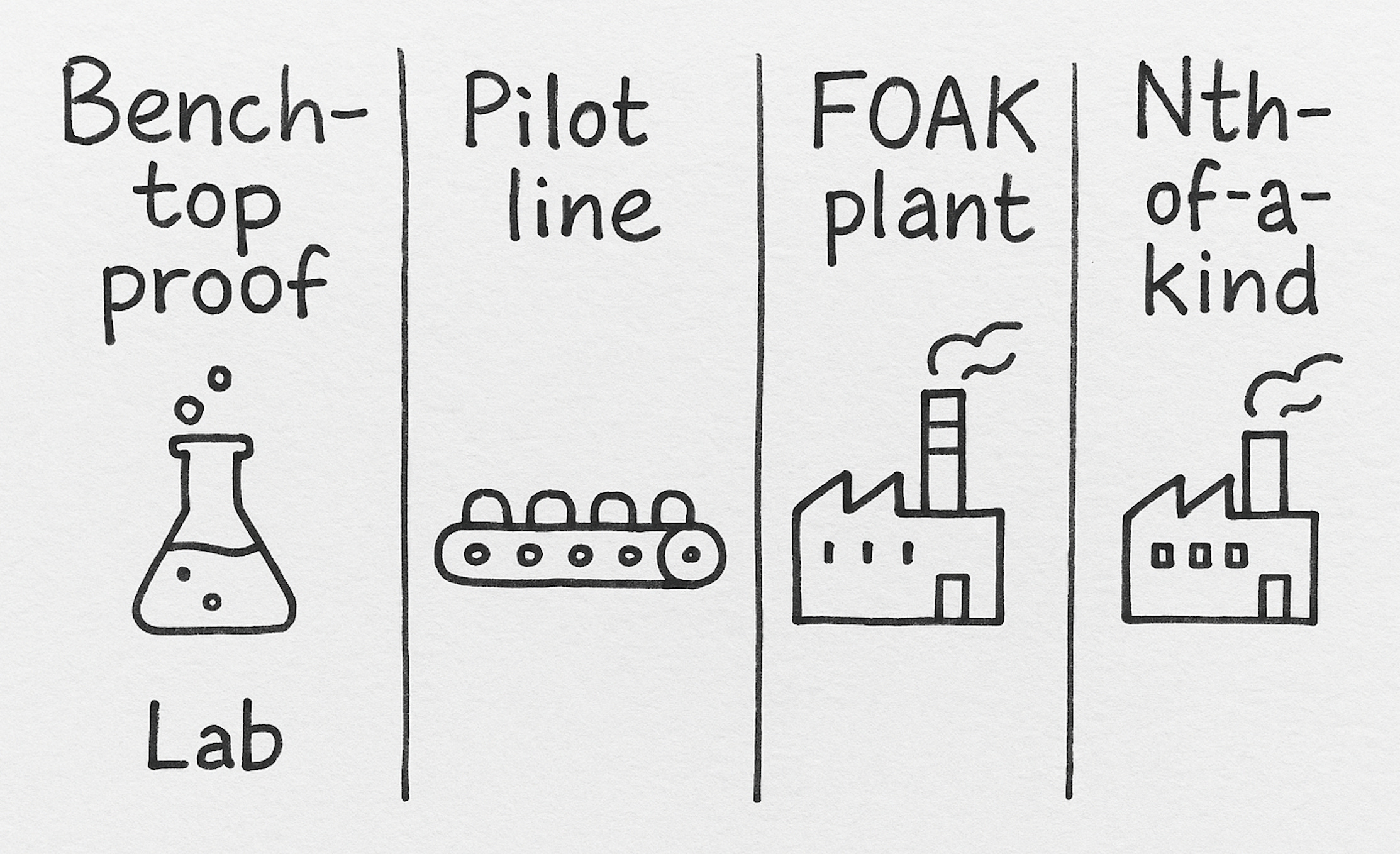
This isn’t just an opportunity, it’s a national imperative
Picture the following handful of critical possibilities:
Silicon-carbide wafers that let EV inverters run cooler and 15 % more efficient.
Sodium-ion and solid-state batteries that shrug off 45 °C summers without thermal run-away.
Gigawatt-scale green-ammonia units that slash our fertiliser import bill and double as hydrogen export hubs.
800 kV HVDC converters to push desert wind from Kutch to distant data-centre with single-digit loss.
Heat-pump-driven HVAC that halves energy use in offices, malls and metro lines now built for 50 °C ambient.
Small-modular-reactor (SMR) plants that serial-produce 300 MW-class reactor cores and steam generators.
Someone out there might be thinking far better and different ways to address these - each one is a moonshot until it is not.The folks who crack them at Indian price points, while still earning global-grade margins, won’t just follow the supply chain - they will write it.
Viewed through this lens, its relevance in the Indian context already has bold reference points:
Biotechnology & Pharma: When a company like Biocon (back in the day) built the insulin plant , that is a FOAK project and what followed were NOAK(nth of a kind)
Aerospace & Robotics: Agnikul’s 3D-printed engine facility is a quintessential FOAK.
Nuclear energy: The prototype 500MWe Sodium cooled fast breeder reactor iin Kalpakkam (yet to be commissioned) is a FOAK.
In short, FOAK is the playbook for turning our scientific know-how into industrial show-how across every critical, high-value sector.
FOAK btw is not a new concept, the term slipped into the project finance lexicon in the early 2000s, heavily popularized by the U.S. Department of Energy’s Loan Programs Office (LPO). It was created to give a specific name to the high-risk, capital-intensive chasm between a successful lab prototype and the first commercial-scale factory.
The LPO used the FOAK designation to justify loan guarantees for these pioneering projects, acknowledging a clear market failure where private capital was too risk-averse to fund the crucial first factory. Since then, the term’s relevance has expanded to UK and EU.
In essence, FOAK has become the official signal for the high capital need, learning-curve, certifications and offtake risks that come with building something the world has never seen before.
How does the Western FOAK playbook look like?
In the U.S. and Europe, the deepest tech leaps arrive through First-of-a-Kind (FOAK) demonstration plants—projects too novel for commercial banks, so they lean on bespoke capital stacks, loan-guarantees, and long-horizon offtake.
Blended capital – public loan programs absorb downside so private equity can price upside
Contracted demand – anchor customers(government?) sign multi-year offtake to de-risk revenue
Learning-rate mandates – detailed cost-drop milestones unlock the next tranche of capital.
The question is, can India graft that muscle onto Make in India bones?
The Barbell Strategy: The only path forward
Wouldn’t China+1 be enough?” It’s a tempting thought. It’s lower risk and delivers immediate results.Let’s look at that :
The margin race: We compete on being the cheapest and most efficient but and when the optionality argument fades, we could end up competing with Vietnam, Mexico, and eventually countries in Africa maybe. It’s a race to the bottom on margins.
No strategic moat: Global brand like Apple or Samsung hold all the power. They own the design, the brand, and the customer relationship. They can decide to move to another country(just as they moved to India),The world has to come to us for that specific technology or process.
The ambition ceiling: A pure assembly economy generates jobs, but it rarely generates the kind of high-value, high-wage jobs that create a wealthy nation. You risk getting stuck in the (not-so)middle-income trap, forever executing someone else’s vision as a contract manufacturer.
So, the answer isn’t FOAK instead of China+1 but in addition to. China+1 - a barbell strategy, if you like. We use the “China+1” wave as the safe, steady, cash-flowing side of the barbell. It builds our manufacturing muscle, absorbs labor, and gets us into global supply chains. It pays the bills today.
In parallel, we take high-conviction bets on the other side of the barbell - a portfolio of FOAK projects in critical sectors. This is the high-risk, high-reward play that builds the IP, the margins, and the strategic autonomy for tomorrow.
So no, merely China+1 is good but not enough in the long run - it makes us a bigger factory. The FOAK strategy is what could what make us an indispensable one.